Presume competence
Honor communication, autonomy, strengths, and support needs without requiring a person to prove their worth.
Choose the presentation that works best for you. Settings stay on this device.
ACCESS BEGINS WITH LISTENING
NeuroHub is an interactive learning lab for translating lived experience into practical supports, shared decisions, and more accessible secondary education.
THE ACCESS LOOP
Support is a process, not a one-time document.Human-ledAI never makes educational decisions.
Privacy-mindedProgress remains in your browser.
Barrier-focusedStart with access, not assumptions.
Designed for choiceLearn, listen, reflect, or explore.
WHY NEUROHUB EXISTS
NeuroHub helps students, families, educators, and support professionals turn lived experience into practical, reviewable support while shifting responsibility from the individual to the systems around them.
Honor communication, autonomy, strengths, and support needs without requiring a person to prove their worth.
Offer meaningful options for engagement, representation, participation, and expression from the beginning.
Define success collaboratively, examine what happened, and adapt supports instead of blaming the student.
THE LEARNING JOURNEY
Move from labels and compliance toward student voice, barrier removal, flexible design, and collaborative review.
Compare a person-focused deficit lens with an environment-focused social model. Ask what barrier can be changed without dismissing real support needs.
Distinguish person-level support needs from barriers created or intensified by an environment.
What changes when the first question becomes ‘What in this environment limits access?’
Rewrite one deficit-framed classroom statement as a barrier-and-support statement.
Notice when students hide natural communication, movement, or regulation needs to appear neurotypical, and consider the possible energy and well-being costs.
Recognize why outward compliance may not be a reliable measure of access or well-being.
Which classroom expectations reward appearance over authentic participation?
Offer two participation options that do not require a student to perform neurotypical behavior.
Explore the shift from school-led IDEA supports to student-requested accommodations after high school, while avoiding a one-size-fits-all view of transition.
Identify self-knowledge, communication, and documentation practices that can support transition planning.
How can transition planning build agency before services and responsibilities change?
Help the student prepare one strengths statement, one barrier statement, and one support request in their own words.
Connect strengths-based, identity-affirming practice to UDL, collaboration, assistive technology, and behavior understood as communication.
Use multiple means of engagement, representation, and action and expression to reduce a learning barrier.
What can an educator redesign this week rather than asking the student to endure?
Choose one lesson and add a meaningful choice for access, participation, or expression.
Move inclusion from ‘How can we fix the person?’ toward shared responsibility for changing environments, policies, instruction, technology, and relationships.
Name who has the power to remove a barrier and how the student will share in the decision.
Who holds the power to remove this barrier, and how will the student share in the decision?
Add a review date and a student-defined sign of success to one support plan.
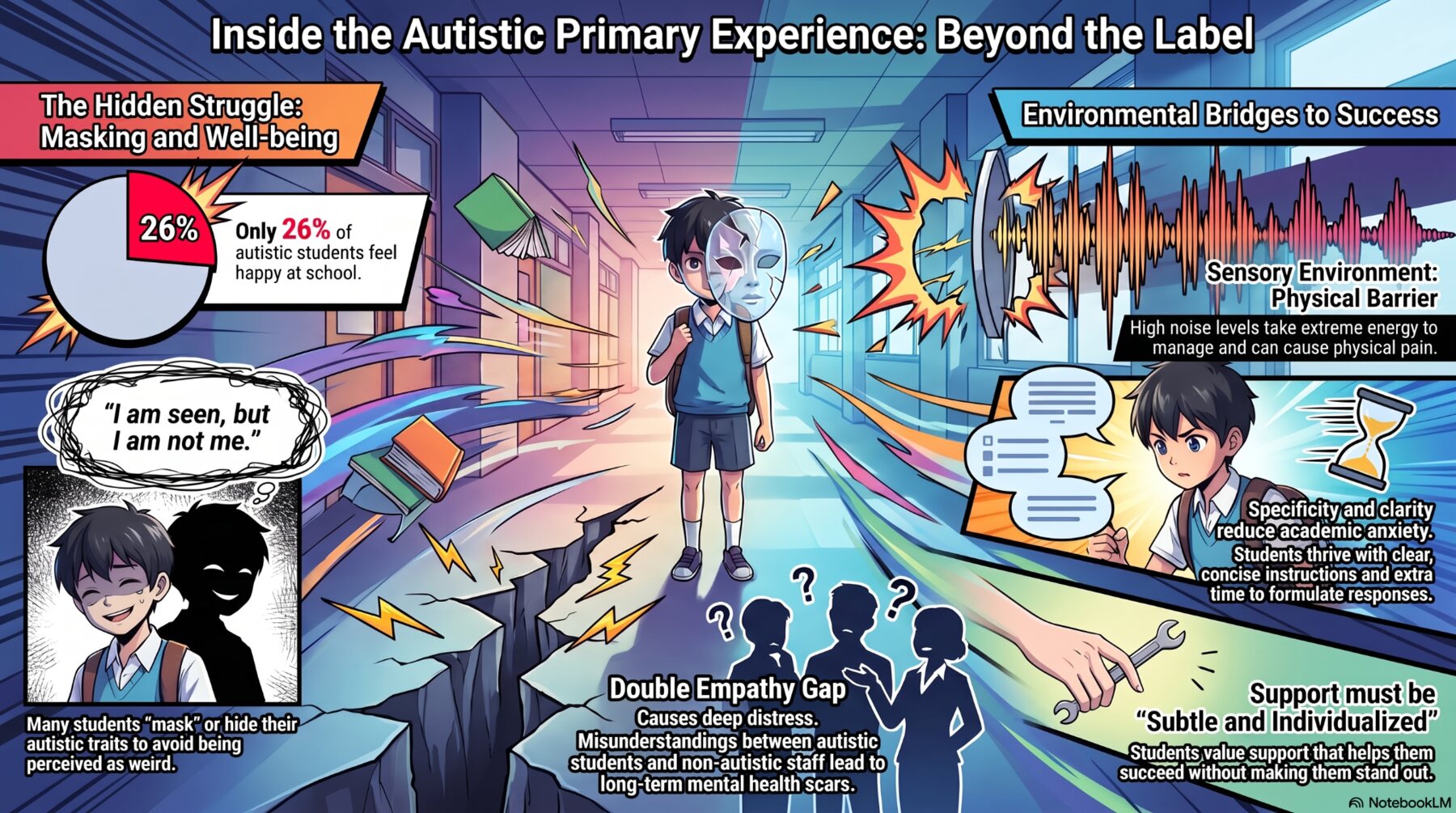
FEATURED CLASSROOM GRAPHIC
When a student suppresses natural movement, communication, sensory responses, or identity to avoid stigma, outward compliance may conceal substantial effort or distress. Educators can reduce that burden through predictable instruction, sensory access, authentic choice, and individualized support.
This AI-assisted graphic is a discussion artifact, not research evidence. Its embedded “26%” statistic and other claims were not verified in the supplied assets and should not be quoted or used academically without checking the original source.
FROM LEARNING TO SELF-ADVOCACY
The Navigator helps a team begin. Bridge the Gap helps a student build a living access profile that can capture strengths, preferences, barriers, strategies being tried, changing needs, questions, and transition goals.
NEUROHUB PODCAST
The audio journey connects medical and social models, classroom masking, transition, system redesign, and the call to shift responsibility toward environments and institutions.
Transcript status: A verbatim transcript was not included in the supplied publishing assets. This structured outline improves access but does not replace a complete transcript. A reviewed transcript should be added before formal institutional use.
CONNECTED ECOSYSTEM
Each resource has a clear role in one connected process: learn, identify a barrier, prepare a conversation, and keep support responsive.
Build a living access profile around strengths, barriers, preferences, and supports that can change over time.
Open the Bridge the Gap prototype (opens in a new tab)Begin with what is happening, then identify questions, practical supports, collaborators, and a plan for review.
Use the navigatorApply UDL, assistive technology, collaboration, student voice, and review to realistic secondary-school situations.
Start the five learning themes
OPTIONAL VOICE-AI EXPERIENCE
Use an externally hosted voice-AI conversation to practice reflection questions and explore how barrier removal can reveal human potential. Participation is optional and is not required to complete NeuroHub.
DESIGN COMMITMENTS
These commitments translate the project’s SOP into visible product decisions.
Semantic structure, keyboard access, strong focus states, responsive layouts, reduced motion, adjustable display modes, no autoplay, and multiple ways to engage.
NeuroHub does not request an account or submit progress data. Display preferences and completed themes stay in local browser storage. External tools have separate practices.
Official sources are identified, unverified claims are labeled, and evidence, framework, policy context, and recommendations are not presented as interchangeable.
AI is transparent and optional. It supports reflection, not diagnosis or eligibility decisions. Human expertise, student voice, and accountable review remain essential.
EVIDENCE AND OFFICIAL GUIDANCE
These external resources support further learning. NeuroHub summarizes concepts for education and reflection; it does not provide legal advice.
Options for multiple means of engagement, representation, and action and expression, with learner agency as the goal.
A filterable implementation reference for perceivable, operable, understandable, and robust digital content.
Official U.S. Department of Education information about IDEA and services for eligible children and youth with disabilities.
Official U.S. Department of Education information about equal access and disability nondiscrimination in covered programs.
U.S. Department of Education resources for protecting student privacy when educational technology is used.
REFLECT AND REVIEW
I can describe a barrier without reducing a person to a diagnosis.
I can identify at least one support to explore with the student.
I can explain why student voice and human review belong in every support cycle.
I know where to verify accessibility, education, and privacy information.
ABOUT NEUROHUB
NeuroHub transforms audio, visuals, course reflections, learning frameworks, and app prototypes into an accessible educational pathway for secondary-school students and the people who support them.